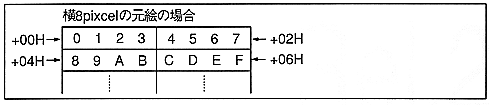
1 pixel is represented by 4 bits. 16 colors can be drawn. 4 bytes are required to represent 8 pixels. 1Byte contains 2pixel data. When left and right are not reversed, the upper 4bit represents the left pixel and the lower 4bit represents the right pixel.
∙ Pallet code is represented by 4 bits, and the upper 12 bits are added with the color bank from the color bank word (command table start address + 06H), and written to the frame buffer as 16-bit data.
∙ At 8bit / pixel (when frame buffer is rotated or high resolution), the lower 8 bits of 16 bits are written to the frame buffer. The upper 8 bits are discarded.
* Since drawing pixel data is a color bank code, color calculation is not possible.

∙ 4 pixels represent 1 pixel. 16 colors can be drawn. Character data is the same as mode 0.
∙ One color data of 16 colors stored in the color lookup table is selected with 4 bits and written to the frame buffer. When 8bit / pixel (when frame buffer is rotated or high resolution), the lower 8 bits of 16 bits are written to the frame buffer.
Write the address of the color lookup table to the lookup table address (command table start address + 06H, shared with the color bank word). The color code of the lookup table can be specified by either color bank code or RGB code. However, RGB code is prohibited at 8bit / pixel.
Figure 6.11 Mode 0, 1 drawing example