(4) Playback range and frame address
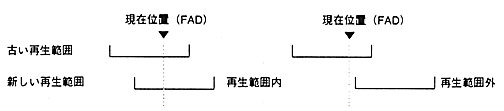
Figure 4.4 Relationship between playback range and current position
In the following operations, FAD is outside the playback range (FAD <start position, FAD> end position).
- Exit playback, change playback range, seek, scan playback, and so on.
- Perform pause release while paused outside the playback range.
∙ Operation outside the playback range depends on whether there is repeat.
For example, when playback ends without repeat, the 〈PAUSE〉 state is entered with FAD = end position + 1, and the PEND flag is set to 1.
Table 4.5 Operation outside the playback range
Operation (command) | No repeat | repeat | ||
state | PEND | state | PEND | |
CD playback ends | FAD = end position + 1 〈PAUSE〉 | 1 | Seek to start position and 〈PLAY〉 | 0 |
CD playback Change playback range | 〈PAUSE〉 | |||
seek | 〈PAUSE〉 | 1 | 〈PAUSE〉 | 0 |
Scan playback | 〈PAUSE〉 | 1 | 〈PAUSE〉 | 0 |
PEND flag 0 means no change.
(5) Seek to the home position (stop)
(A) The disk motor stops rotating and the pickup moves to the inner standby position.
(B) The CD drive status changes to 〈STANDBY〉, and the report becomes an invalid value (sequence of FFH).
(C) When the 〈PAUSE〉 state is entered at the home position, the pickup moves to the top of the disk.
(D) The playback range, maximum repeat count, and repeat notification count are not changed.
(6) Pickup position in 〈STANDBY〉 state
- When transitioning from 〈PAUSE〉 state: Current position (the report is also unchanged)
- When seeking to the home position: inner circumference standby position (report is invalid)