Return to previous page | Return to menu | Go to next page
map
A map is the maximum scroll unit that SGL actually uses for scroll drawing. The map is represented by 2 horizontal x 2 vertical planes for the normal scroll screen and 4 horizontal x 4 planes for the rotating scroll screen.
The planes composing the map can be arbitrarily specified (no need to be continuously stored in the VRAM) by specifying the top address of each plane (actually, the top address stored in the pattern name data table configuring the plane). Can be determined. For this reason, it is possible to make all the planes that make up the map the same.
The scroll movement, scaling, and rotation described later are also moved and converted in map units.
Figure 8-14 Map image
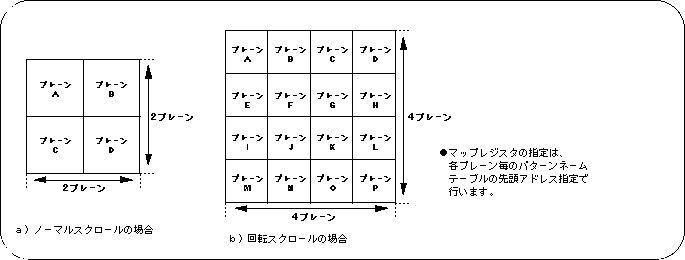
- Map size is determined by the type of scroll screen.
- Normal scroll screen: 4 planes (2 horizontal x 2 vertical)
- Rotation scroll screen: 16 planes (4 horizontal x 4 vertical)
Use the library functions “slMapNbg0-3” and “sl1MapRA, RB” to register each plane that composes a map in SGL.
- [void slMapNbg0-3 (void * map_a, void * map_b, void * map_c, void * map_d);]
- Register plain data in the map of each normal scroll screen.
For each parameter, substitute the top address of the 4 planes to be registered. The target scroll screen corresponds to the normal scroll screen name at the end of the function name.
- [void sl1MapRA (void * map_a);]
- [void sl1MapRB (void * map_a);]
- Register plane data in the map of the rotary scroll screen.
For each parameter, substitute the start address of the plane to be registered. The function is
from the specified address
Register one page of plain data in the map.
Function “sl1MapRA” is used for map registration when rotation parameter A is used, and function “sl1MapRB” is used for map registration when rotation parameter B is used.
Caution
For details on the rotation parameters, refer to “Function settings specific to the rotary scroll screen” described later.
Return to previous page | Return to menu | Go to next page